

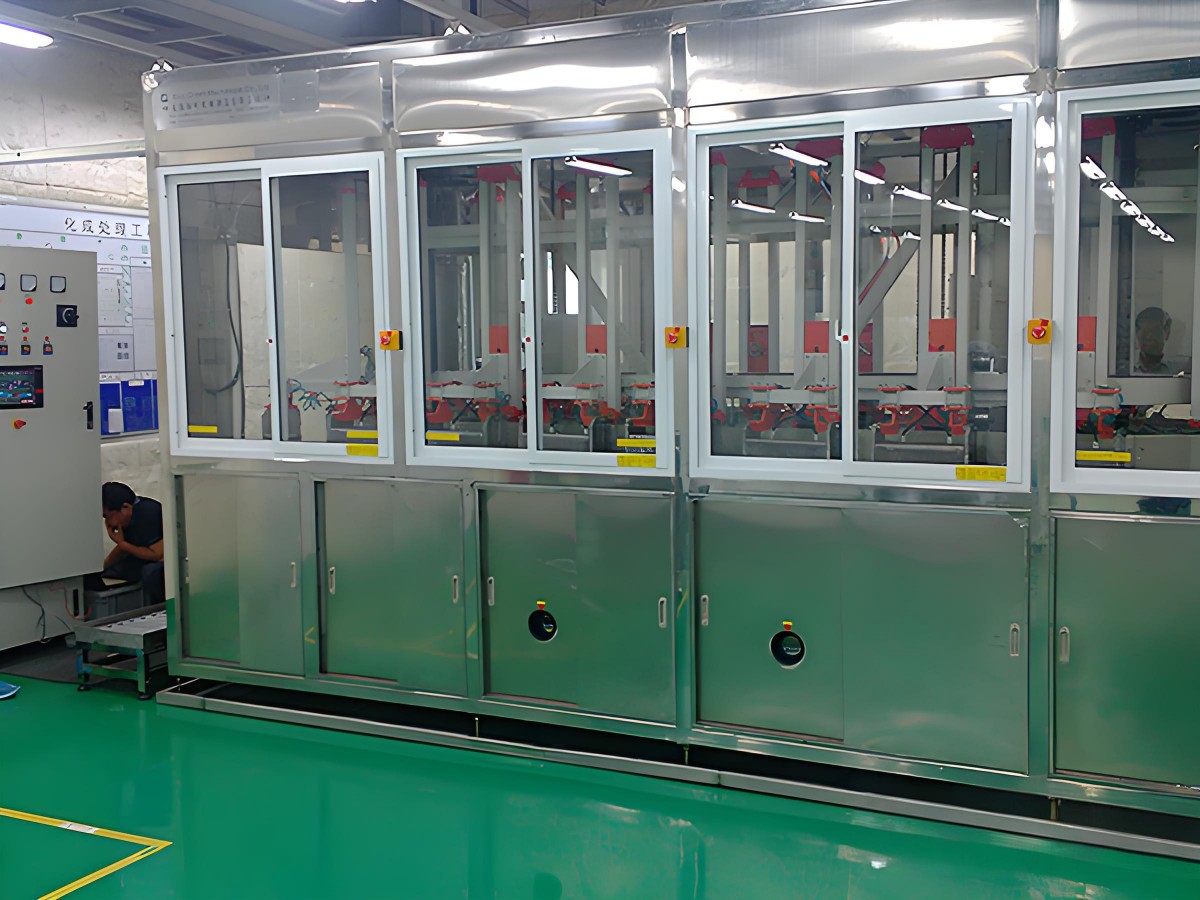
Circular Phosphating Production Line
The Circular Phosphating Production Line, typically referring to an “Overhead Continuous Conveyor” type line, is a mature, high-efficiency continuous automated processing system. Its core is a closed-loop, overhead-installed circular conveyor chain (power & free or similar). Racks carrying the workpieces are suspended from trolleys on the chain. The racks move continuously at a constant speed, sequentially passing through the various process chambers (e.g., enclosed spray tunnels or immersion tanks) arranged below the track. This layout concentrates the process zones under a circular track, offering a compact footprint. It is particularly suitable for medium-volume continuous production with multiple process steps and stable cycle times.
As manufacturers continue to improve production efficiency while maintaining consistent coating quality, automated surface treatment systems have become an essential part of modern manufacturing. Among the various pretreatment solutions available today, the Circular Phosphating Production Line has earned a strong reputation for its stable operation, compact layout, and high production efficiency.
Widely used in industries such as automotive manufacturing, household appliances, office furniture, and industrial equipment, this type of production line provides an ideal foundation for subsequent processes like electrophoretic coating, powder coating, and spray painting.
If your factory requires continuous processing with reliable pretreatment quality, a circular phosphating line may be the right investment.
What Is a Circular Phosphating Production Line?
A Circular Phosphating Production Line is an automated continuous pretreatment system that uses an overhead conveyor to transport workpieces through multiple processing stages.
Instead of moving products in a long straight line, the conveyor follows a closed-loop circular path. Workpieces are suspended from specially designed racks that travel continuously through enclosed spray tunnels or immersion tanks.
Typical processing stages include:
-
Degreasing
-
Water rinsing
-
Surface conditioning
-
Phosphating
-
Final rinsing
-
Drying preparation
Once the phosphating process is completed, the workpieces are transferred directly to the next production stage without manual handling.
Why More Manufacturers Prefer Circular Layouts
Traditional straight-line pretreatment systems often require significant factory length, which is not always available.
A circular conveyor layout solves this problem by arranging the entire production process within a compact footprint.
This design provides several practical benefits:
-
Better utilization of workshop space
-
Shorter internal logistics routes
-
Continuous product flow
-
Easier integration with automated coating equipment
-
Reduced manual intervention
For factories with limited building length but sufficient floor width, the circular configuration is often a highly efficient solution.
Stable Continuous Production Improves Efficiency
One of the biggest advantages of a circular phosphating line is continuous operation.
Unlike batch processing systems that require frequent loading and unloading, the overhead conveyor continuously moves workpieces through every treatment stage at a controlled speed.
This creates several operational advantages:
-
Stable production rhythm
-
Higher hourly output
-
Consistent processing time
-
Reduced waiting between production stages
-
Better production planning
For manufacturers producing large volumes of similar metal components, continuous processing helps maximize equipment utilization while reducing production costs.
Consistent Surface Treatment Quality
Surface pretreatment directly affects coating adhesion, corrosion resistance, and final product appearance.
A circular phosphating production line ensures every workpiece follows the same processing sequence with identical residence time inside each treatment chamber.
As a result, manufacturers benefit from:
-
Uniform phosphating film formation
-
Improved coating adhesion
-
Better corrosion protection
-
Reduced quality variation between batches
-
More stable downstream painting performance
This consistency is especially important for industries with strict quality standards.
Suitable for Multiple Industries
Because of its flexibility and reliable performance, circular phosphating systems are widely used across many industrial sectors.
Typical applications include:
Automotive Components
Vehicle bodies, structural parts, brackets, and stamped metal components all require reliable pretreatment before painting or electrophoretic coating.
Household Appliances
Refrigerator cabinets, washing machine panels, air conditioner housings, and other appliance components benefit from uniform phosphating to improve coating durability.
Office Furniture
Steel filing cabinets, lockers, shelving systems, desks, and storage equipment require corrosion-resistant surface treatment before powder coating.
Industrial Equipment
Metal enclosures, electrical cabinets, machinery frames, and fabricated steel parts can all be processed efficiently using continuous phosphating technology.
Engineering Features That Improve Performance
Modern circular phosphating production lines incorporate several advanced engineering technologies designed to improve both productivity and process stability.
Precision Overhead Conveyor System
The overhead conveyor maintains accurate positioning of workpiece racks throughout the production cycle.
Carefully engineered anti-sway mechanisms minimize movement while racks enter spray chambers, ensuring even chemical coverage and reducing the risk of collisions.
Efficient Spray Tunnel Design
Modern spray tunnels are designed with multiple spray angles to achieve complete coverage across complex workpiece surfaces.
Labyrinth sealing structures help minimize chemical loss while improving spray efficiency.
At the same time, recirculation and filtration systems reduce water and chemical consumption, lowering overall operating costs.
Independent Process Zone Control
Each treatment chamber can be independently controlled for:
-
Temperature
-
Humidity
-
Exhaust airflow
-
Chemical concentration
Maintaining stable environmental conditions helps ensure consistent phosphating quality throughout long production runs.
Easy Integration with Coating Lines
One of the greatest advantages of circular phosphating systems is their compatibility with automated finishing lines.
They can be integrated directly with:
-
Electrophoretic coating lines
-
Powder coating systems
-
Spray painting booths
-
Drying ovens
-
Intelligent factory control systems
This creates a fully automated production workflow with minimal manual handling.
Is a Circular Phosphating Line Right for Your Factory?
Although circular systems offer many benefits, they are best suited for manufacturers with stable production volumes and relatively consistent product sizes.
They perform particularly well when:
-
Production is continuous rather than batch-based.
-
Multiple processing stages are required.
-
Product dimensions remain relatively consistent.
-
Automation is a long-term production goal.
-
Space efficiency is important.
For factories processing extremely large, heavy, or irregularly shaped components, alternative systems such as gantry-type phosphating lines may provide greater flexibility.
Planning for Future Expansion
One important consideration during project planning is future production requirements.
Because the circular conveyor follows a fixed closed-loop layout, adding new processing stages later can require significant equipment modifications.
For this reason, experienced system suppliers typically recommend designing the complete process flow—including potential future upgrades—during the initial engineering stage.
Proper planning helps reduce future investment costs while ensuring the production line remains adaptable as manufacturing needs evolve.
Final Thoughts
A Circular Phosphating Production Line combines continuous automation, compact plant layout, and reliable surface treatment performance into a single integrated solution. Its overhead conveyor system, efficient spray technology, precise process control, and compatibility with modern coating equipment make it an excellent choice for manufacturers seeking stable, high-volume production.
Whether producing automotive components, household appliances, office furniture, or industrial equipment, investing in a well-designed circular phosphating system can improve production efficiency, enhance coating quality, and support long-term manufacturing competitiveness. By choosing a solution that balances process reliability with intelligent automation, manufacturers can build a more efficient and future-ready surface treatment operation.
Related products
-
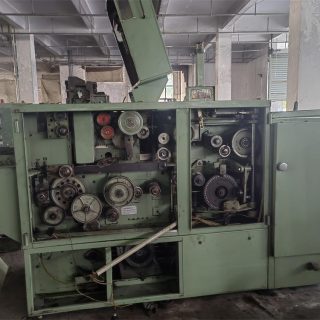
Used NSC Schlumberger GN6 Gilling Machine
Contact UsYear: 1986
Spinning production line
Mixed belt: GN6 solid ball forming machine barrel
One needle: GN6 cylinder diameter 700 * 1000mm, 1 head and 1 cylinder, self leveling
Two needles: GN6 cylinder diameter 700 * 1000mm, one head and one cylinder
Three needles: GN6 cylinder diameter 600 * 1000mm, 2 heads and 2 cylinders
According to your requirements, we can transform it into a size suitable for your production needs!
Reviews
There are no reviews yet.