

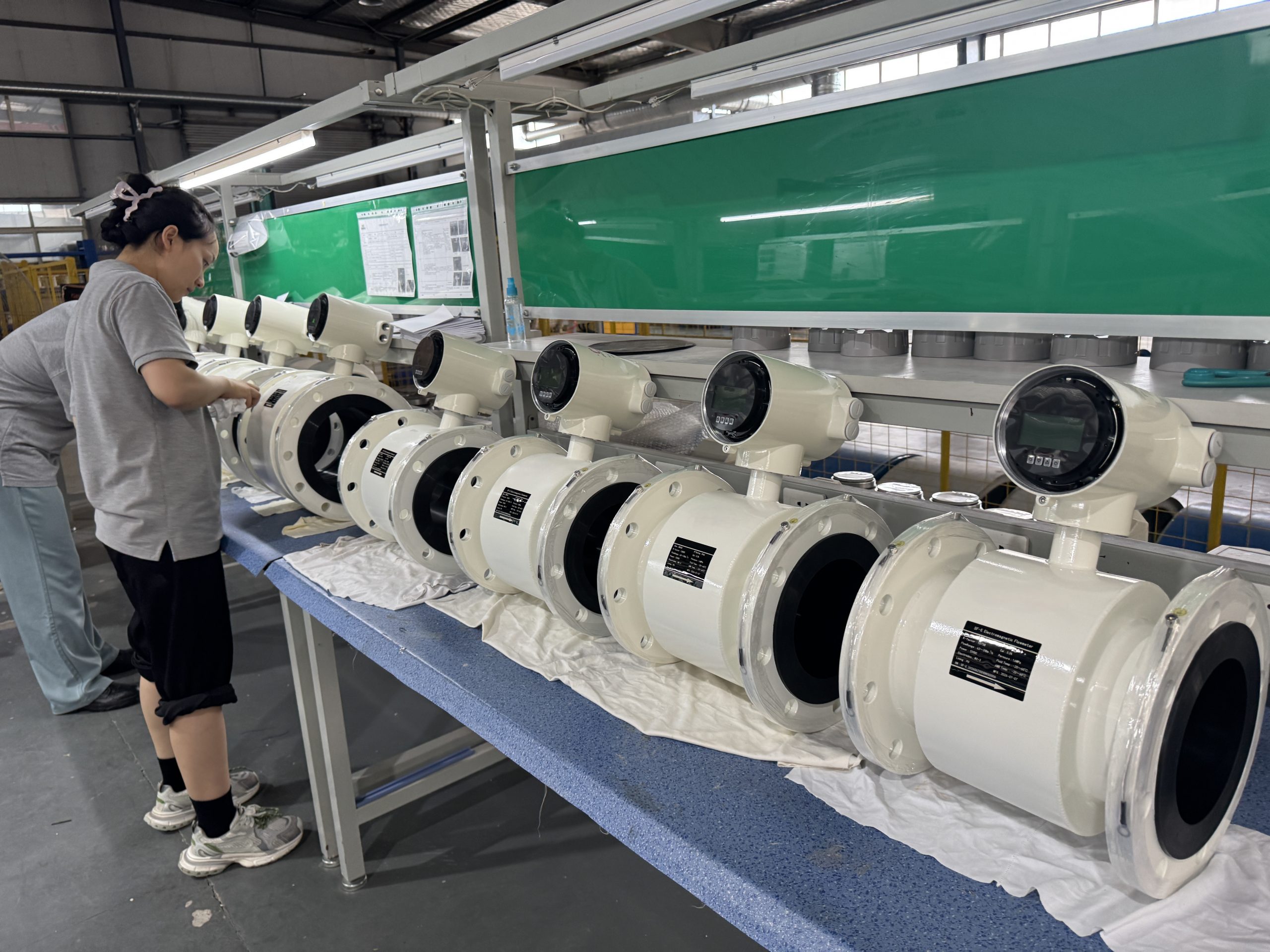

Polyurethane Lined Flowmeter for Mineral Process Water Reuse
Find out whether recycled mineral process water needs a wear-resistant flowmeter liner by assessing residual solids, particle properties, conductivity, and chemistry.
Does Recycled Mineral Process Water Need a Polyurethane-Lined Electromagnetic Flowmeter?
Not automatically. Recycled mineral process water does not, by default, require a polyurethane-lined electromagnetic flowmeter. The need for a wear-resistant polyurethane liner depends on three practical factors: how much residual suspended solid remains after reclamation, whether that solid is hard and abrasive rather than soft and inert, and whether the liquid’s chemistry and conductivity are compatible with electromagnetic measurement in the first place. Visible turbidity or cloudiness in reclaimed water is not, on its own, proof that a liner upgrade is justified.
This article is a practical screening guide for mineral processing engineers, water reuse system designers, plant operators, and instrumentation purchasers who are specifying flow metering on recycled process water loops — not a guarantee that any single liner material is correct for your site.
1. What Residual Solids May Remain in Recycled Mineral Process Water?
Even after thickening, clarification, or filtration stages, recycled process water from mineral operations can carry:
- Fine clay or silt particles that escaped settling
- Residual ore fines or mineral dust carried over from flotation or grinding circuits
- Precipitated chemical residues from reagents, flocculants, or pH adjustment
- Scale or mineral deposits that form as water chemistry shifts during reuse cycles
The composition varies significantly by ore type, upstream separation efficiency, and how many reuse cycles the water has gone through. A water reuse loop near a flotation circuit will carry a different solids profile than one downstream of a tailings thickener overflow.
2. When Do Suspended Solids Create a Meaningful Abrasion Concern?
Abrasion risk is not just about whether solids are present — it is about the mechanism of contact and wear. Several variables interact:
- Particle hardness: Hard mineral fines (quartz, certain ore gangue) are more abrasive than soft organic or clay-like fines.
- Particle size and shape: Angular, coarse particles tend to cause more localized wear than fine, rounded particles.
- Solids concentration: Low parts-per-million carryover behaves differently from a slurry-like residual load.
- Flow velocity: Higher velocities increase particle impact energy against the liner and electrodes.
- Liquid chemistry: Corrosive or chemically reactive residues can combine with abrasion to accelerate liner degradation.
- Temperature and pressure: Elevated temperature or pressure conditions can change how liner materials respond over time.
A meaningful abrasion concern typically arises when multiple factors align — for example, hard, angular particles at non-trivial concentration moving at higher velocity — rather than any single factor in isolation.
3. When Is a Standard Water-Service Liner Potentially Sufficient?
If the recycled water has been through effective clarification and the residual solids are low in concentration, predominantly soft or fine, and the liquid chemistry is within normal process water ranges, a standard liner material intended for general water service may be adequate. This is common in recycled water loops used for dust suppression, general washdown, or non-contact cooling, where solids carryover is incidental rather than structural.
4. When Should Polyurethane Be Evaluated?
Polyurethane lining should be evaluated — not assumed — when the process data indicates a combination of hard particulate content, elevated solids concentration, and flow conditions that point to ongoing mechanical wear at the sensor liner and electrodes. Xinya Instrument’s published selection information lists polyurethane as a wear-resistant lining option considered for certain slurry-type applications, alongside other resistant materials such as PFA. This positions polyurethane as one option to be assessed against actual conditions, not a default recommendation for every recycled or reused water stream.
5. What Process Data Should Buyers Provide for a Proper Evaluation?
Before specifying a liner, buyers should be prepared to share:
- Approximate suspended solids concentration and, if known, particle size distribution
- Source and composition of the solids (mineral fines, chemical residue, scale, etc.)
- Typical and peak flow velocity at the metering point
- Liquid temperature and operating pressure range
- Any chemical additives, reagents, or pH conditioning present in the recycled stream
- Pipe diameter and installation orientation
This data allows the liner decision — and the conductivity suitability check required for any electromagnetic flow measurement — to be made against actual conditions rather than assumptions.
Decision Table: Liner Screening for Recycled Mineral Process Water
| Water Condition | Typical Consideration |
|—|—|
| Low suspended solids, mostly soft/fine particles | Standard water-service liner may be sufficient, pending site review |
| Hard mineral fines at meaningful concentration and velocity | Wear-resistant liner, potentially including polyurethane, should be evaluated |
| Chemical residues or reagent carryover present | Liquid chemistry compatibility must be checked before any liner selection |
| Conductivity uncertain or near measurement limits | Conductivity must be confirmed before electromagnetic metering is finalized |
Buyer Checklist
- [ ] Have you quantified suspended solids concentration in the recycled stream, not just observed turbidity?
- [ ] Do you know whether the residual solids are hard mineral particles or soft/organic fines?
- [ ] Have you recorded actual flow velocity at the proposed metering location?
- [ ] Have you identified any chemical residues, reagents, or pH adjustments present in the water?
- [ ] Has liquid conductivity been confirmed as suitable for electromagnetic flow measurement?
- [ ] Have you compared liner options against your current datasheet requirements rather than assuming one material fits all conditions?
FAQs
Q1: Is polyurethane always the best liner for recycled mineral process water?
No. Polyurethane is one wear-resistant option among several, and whether it is appropriate depends on actual particle hardness, concentration, and flow conditions — not simply because the water is "recycled" or "mineral process" water.
Q2: Can recycled water have low solids but still need a resistant liner?
It is possible if the residual particles are hard and the flow velocity is high, even at modest concentration. Each case should be reviewed on its own data rather than generalized.
Q3: Does visible cloudiness in reclaimed water mean abrasive wear is occurring?
Not necessarily. Cloudiness can come from fine, soft particles that create little to no abrasive wear. Hardness, size, shape, and velocity matter more than visual turbidity alone.
Q4: Should conductivity be checked separately from the liner decision?
Yes. Liner selection addresses mechanical wear resistance, while conductivity suitability is a separate requirement for any electromagnetic flowmeter to function correctly, and should be confirmed independently.
Q5: Who should buyers consult before finalizing a liner choice?
Buyers should review current manufacturer datasheets and configuration guidance — for example, Xinya Instrument’s published selection materials — and provide actual process data so the liner and instrument configuration can be matched to real operating conditions rather than general assumptions.
Related products
-
ABR-Birotor Flowmeter with electronic counter for DN15~DN400
Contact UsAs the first product developed by our company, double-rotator flowmeter has undergone a long period of improvement and development. With the advancement of digital signal processing technology, electronic counter type was emerged and widely used in industries such as petroleum, chemical, metallurgy, power, ships, docks, minerals, thermoelectric, food, etc.


Reviews
There are no reviews yet.