


Robotic Hand Actuator 24V DC Bus Compatibility Guide
Our Φ16–30mm micro joints adopt axial-flux motors, cycloidal reducers and encoders for high rigidity & torque across varied loads.
For engineers designing dexterous robotic hands, the actuator is rarely chosen in isolation. It must fit inside a finger-sized envelope, deliver meaningful torque, report its position accurately, and — perhaps most decisively — operate cleanly on the DC bus that already powers the rest of the robot. The 24V DC bus has become a common design baseline for integrated robotic systems because it balances voltage headroom against safety and wiring constraints. Understanding how a joint actuator behaves on that bus, and what interface it presents to the host controller, is therefore a practical engineering question.
Why 24V DC Bus Compatibility Matters for Robotic Hand Actuators
Voltage flexibility determines how many system architectures a single module can serve. A module that accepts only one rail forces designers into separate SKUs for each robot platform; a module that spans multiple rails reduces inventory complexity and shortens integration timelines.
Bus compatibility also affects control architecture. Communication protocols such as SPI and CAN FD travel alongside power on the same interface, so the actuator’s electrical and data characteristics must be considered together rather than separately.
Thermal behavior is the third variable. Continuous duty at a given bus voltage produces predictable power loss, which in turn drives chassis temperature. Modules that publish explicit thermal thresholds allow designers to plan duty cycles rather than discover limits during testing.
The VAXOR-MOTOR Approach to Integrated Micro-Actuation
VAXOR-MOTOR (also referenced as VAXOR) positions itself as a provider of integrated micro-actuation solutions, specializing in axial flux motors, cycloidal gear reducers, and non-contact encoder integration. The company’s stated industry focus is the need for high torque density, precision, and compact footprints in micro-manipulation and high-load robotic applications.
Rather than supplying loose components, VAXOR-MOTOR combines an axial flux motor, a micro cycloidal gear reducer, and a non-contact absolute magnetic encoder into a single technology platform. The electromagnetic design is tuned to hold phase imbalance within 5% for ultra-micro motors, a specification the company links to both yield and power density. Business coverage is global, with stated suitability for bionic robots, industrial automation, medical devices, and consumer electronics.
Platform Compatibility: 12V, 24V, and 48V DC Bus Systems
The most direct answer to the compatibility question is that the VAXOR-MOTOR platform supports 12V, 24V, and 48V DC bus systems. Within the product matrix, this flexibility is stated explicitly for the Φ20mm Micro Joint Module, which is described as supporting 12V/24V/48V operation. For a robotic hand designer working on a 24V architecture, that means the module can be specified without a voltage-conversion stage dedicated to the actuator alone.
Openness is addressed through the communication and physical interface layer. The modules use SPI and CAN FD as communication protocols, and present an FPC 7PIN interface with 0.5mm pitch supporting VCC, GND, CS, SCK, MOSI, MISO, and CAL (calibration) signals. The inclusion of a dedicated calibration line in a seven-pin footprint is a design detail that matters during production ramp, since it allows calibration to travel with the same ribbon that carries power and data.
Φ20mm Micro Joint Module (X20S / X20L): A 24V-Compatible Building Block
For robotic hand applications specifically, the X20S / X20L family is positioned as medium-load precision actuation for bionic and automation applications. Its key differentiated value is high torque density, with continuous stalling torque >17.2 mNm and stalling torque (max) >35.3 mNm, alongside the versatile voltage support noted above.
Three core features are relevant to a 24V integration:
- Multi-ratio gearbox available in 15, 30, and 50 ratios, balancing speed and torque requirements within one module family.
- High stalling torque (assembly) reaching up to 450 mNm at ratio 50, supporting high-load robotic joints.
- FPC 7PIN interface providing standardized wiring for power and data, simplifying integration into robotic limbs.
The Φ16mm Module: Precision Micro-Manipulation
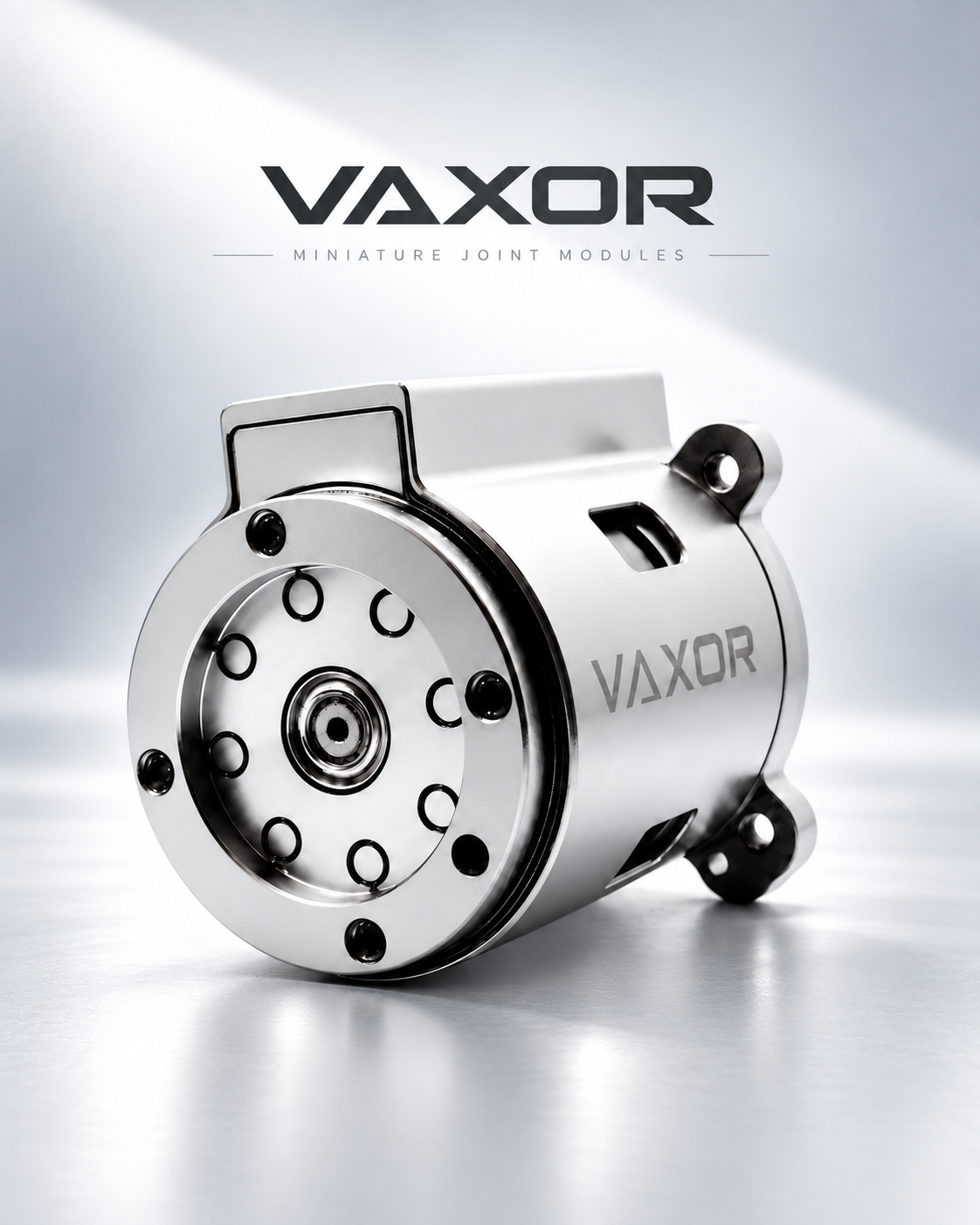
Where hand designs demand an even smaller footprint, the Φ16mm Micro Joint Module (X16S / X16L) targets precision micro-manipulation for highly integrated robotic systems. Units weigh as little as 24.3g (S-version) or 26.1g (L-version). Torque performance is stated as continuous stalling torque >7.1 mNm and stalling torque (max) >16.5 mNm.
Integrated gear reduction is available in ratios of 30, 40, and 50, providing high torque in a 16mm diameter footprint. The module integrates an absolute magnetic encoder for precise position feedback, uses SPI communication for high-speed data exchange with low-latency control response, and applies thermal management with chassis temperature limits of 80°C / 115°C / 145°C based on power loss.
Extending the Range: Φ25mm and Φ30mm Modules
Larger joints in an integrated robot often share the same 24V bus, so cross-family consistency matters. The Φ25mm Micro Joint Module (X25S-UZ / X25S-BZ) is positioned for industrial and medical robotics, using CAN FD for robust industrial environments. It offers continuous stalling torque up to 1150 mNm (Ratio 50), reduced backlash of 15 Arcmin, and a torque capacity reaching 1800 mNm in the initial torque cold state.
The Φ30mm Micro Joint Module (X30S-UZ / X30S-BZ) serves heavy-duty micro-robotic applications, with continuous stalling torque up to 1500 mNm (Ratio 50) and up to 75% gear efficiency at ratio 30. It supports CAN FD integration for multi-joint network architectures and handles a total inertia of 30.4 gcm².
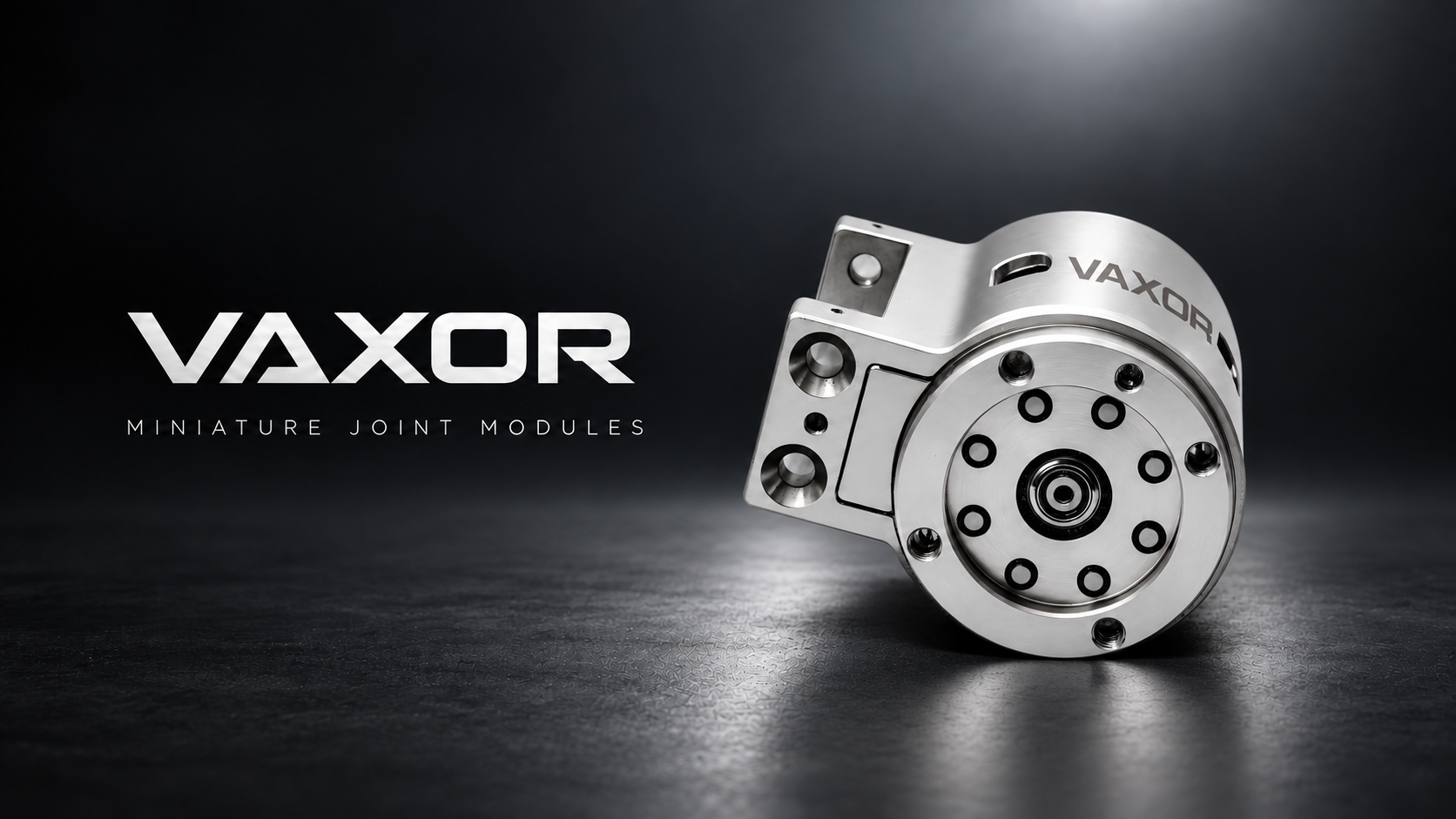
Across the actuator range, gear efficiency reaches up to 75% for specific modules, backlash is as low as 15-20 Arcmin, and actuator diameters span Φ16mm to Φ30mm.
Ultra-Micro Brushless and Coreless Motors
Some hand and end-effector designs require a discrete motor rather than an integrated joint module. The G04P / G05P / G06P series addresses ultra-compact power for precision instruments, where the stated pain point is high cost and low yield in sub-6mm motor production. The series is ultra-lightweight at 1.7g to 3.75g with speeds up to 63,000 RPM, and no-load speeds from 55,000 to 63,000 RPM. Phase imbalance within 5% is presented as a yield and reliability advantage, terminal resistance is as low as 1.6Ω, and chassis temperatures up to 145°C are supported.
Integration and Support Model
VAXOR-MOTOR operates a hardware provision plus technical integration support service model. The company provides detailed technical specifications and test data for electric drive assemblies covering torque, speed, and thermal parameters. Deployment is described as hardware integration with standardized FPC 7PIN interfaces or CAN FD / SPI communication protocols, with after-sales support for product specifications and operational parameter ranges.
Validated Applications
Benchmark cases described by the company span several domains. Robotic dexterous hands have used X16 and X20 modules to achieve high-integration mechanical motion control enabling human-like finger dexterity. Industrial automation systems integrated Φ30mm modules into precision transmission systems, achieving gear efficiency of 75% and reducing mechanical backlash to 15 Arcmin. Micro pump systems employed G05P ultra-micro motors at 55,000 RPM for fluid transmission in medical and consumer applications. Photon optics applications used ultra-micro brushless motors for precision positioning in optical instruments, relying on phase imbalance under 5% for stable performance.
What This Means for a 24V Robotic Hand Design
For a designer evaluating actuator options on a 24V DC bus, the relevant checklist is straightforward: confirm multi-rail voltage support, confirm the communication protocol matches the host architecture, confirm the mechanical interface footprint, and confirm published thermal limits. On those criteria, the VAXOR-MOTOR platform documents 12V/24V/48V support, SPI and CAN FD protocols, an FPC 7PIN 0.5mm pitch interface with a dedicated calibration pin, explicit chassis temperature thresholds, and a diameter range from Φ16mm to Φ30mm — a combination that gives robotic hand integrators a defined starting point rather than a set of assumptions.
Reviews
There are no reviews yet.